
8 Benefits of After-School Boxing for Kids and Teens
Last Updated: November 4, 2026
Quick Summary
After-school boxing builds cardiovascular health, strength, agility, and hand-eye coordination while teaching sustained focus, emotional regulation, discipline, and self-defense. Well-run youth programs start non-contact, introduce sparring gradually, and reinforce a school-first culture that supports grades and behavior at home.
- A 2026 study reported by U.S. News found after-school sports participants show advantages in brainpower, mental health, and physical fitness.
- A 2022 scoping review reports preliminary evidence that non-contact boxing may benefit depression, anxiety, PTSD, and negative mood.
- In well-run youth programs, early training is typically non-contact and sparring is the last step, not the first.
- Ages 5 to 8 usually focus on movement games, footwork, balance, and light bag work with no partner contact.
- A federal review describes after-school programs as mixed for short-term academic achievement and long-term reductions in juvenile crime.
Table of Contents
- Why After-School Boxing Beats Another Screen-Time Afternoon
- The Physical Benefits of Youth Boxing: Conditioning That Sticks
- Mental Resilience, Focus, and Boxing for Kids With ADHD
- Discipline, Self-Defense, and the Confidence That Follows
- Youth Boxing Safety: What Parents Should Ask Before Signing Up
- What to Look for in Youth Mentors and a Reputable Gym
- How Boxing Supports Grades, Behavior, and Life at Home
- Request More Info From TEAM DNA Boxing Club
- Frequently Asked Questions
Why After-School Boxing Beats Another Screen-Time Afternoon
The hours between the final school bell and dinner are when good habits either take root or fall apart. The benefits of after-school boxing start with something simple: a child who has somewhere to be, someone expecting them, and a reason to push past “I can’t.”
Recent research backs the broader idea. A 2026 study reported by U.S. News & World Report’s coverage of after-school sports research found that children and teens in after-school sports show measurable advantages in brainpower, mental health, and physical fitness. Boxing adds structure: every round has a purpose, and every drill builds a skill.
Here is what we cover below: eight benefits, the safety questions every parent should ask, and how to spot a gym worth your child’s time.
The Physical Benefits of Youth Boxing: Conditioning That Sticks
Boxing is a full-body workout disguised as a sport. Jump rope builds cardiovascular health, footwork drills sharpen agility, bag work develops strength, and bodyweight exercises fill the gaps.
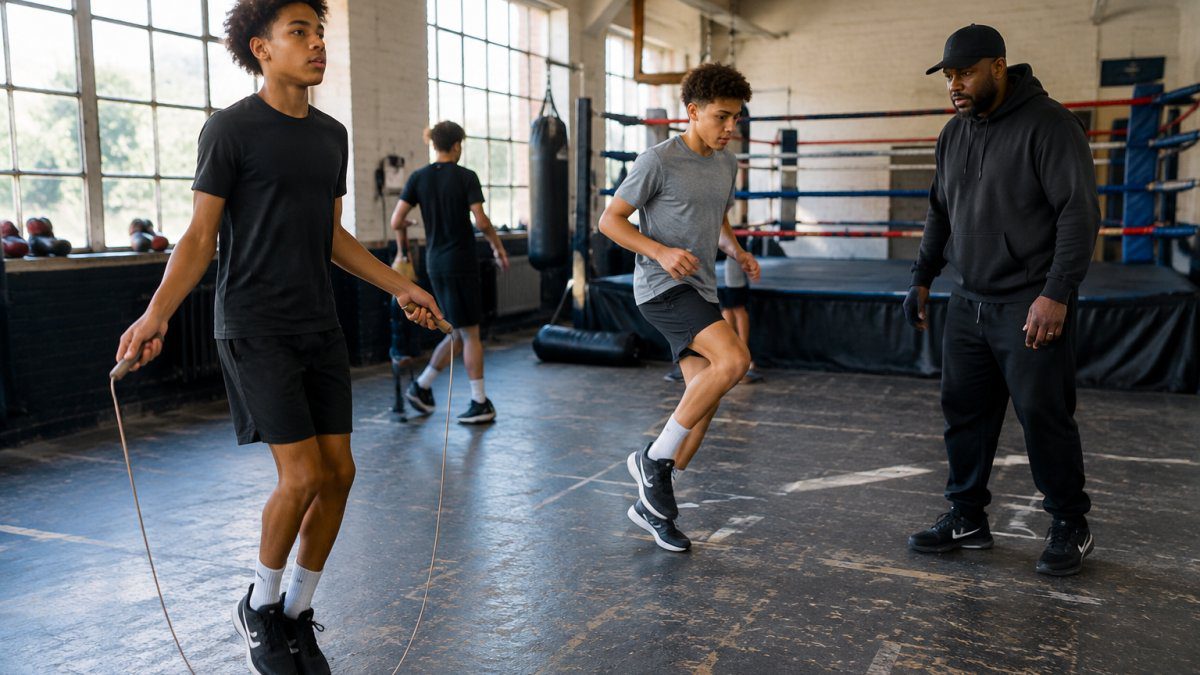
The payoff goes beyond fitness. Hand-eye coordination and reaction time improve with every pad session, and those reflexes carry into other sports and everyday life. The benefits of youth boxing show up in posture, stamina, and motor skills long before anyone steps into a ring.
Mental Resilience, Focus, and Boxing for Kids With ADHD
Boxing teaches a skill many kids with ADHD struggle to find elsewhere: sustained focus under pressure. A coach calls a combination, the boxer repeats it, and the sequence demands attention in a way a lecture never will. Research published in a 2022 scoping review on boxing and mental health reports preliminary evidence that non-contact boxing may benefit symptoms of depression, anxiety, PTSD, and negative mood. That evidence is early, and it concerns boxing interventions generally rather than youth programs specifically, but the direction is encouraging.
Emotional regulation comes from repetition. A missed combination is not a failure; it is the next rep. Kids learn to reset, breathe, and try again. For families working on confidence, our guide on how to build confidence in teenagers pairs well with what happens in the gym.
Discipline, Self-Defense, and the Confidence That Follows
Parents often ask whether boxing just teaches kids to fight. It does the opposite when the program is built right. Discipline comes first: respect for the coach, respect for the partner, respect for the rules. Self-defense skills follow, taught as a last resort rather than a first response.
Confidence building happens quietly as skills develop over time. If you worry about aggression, read our piece on teaching self-defense without promoting aggression before your first visit.
Youth Boxing Safety: What Parents Should Ask Before Signing Up
Safety is the question that should come first, and any gym worth your trust will welcome it. The single most useful distinction for a parent is non-contact versus contact boxing. In a well-run youth program, early training is typically non-contact. Contact is introduced gradually, and sparring is the last step, not the first.
Ask whether the gym follows a written progression from fundamentals and conditioning to supervised sparring, and whether coaches hold current USA Boxing coaching credentials and the gym carries liability insurance.
Equipment is part of the safety conversation, not an afterthought. Ask which equipment the gym supplies or requires, how gloves are sized, and how equipment is cleaned and whether loaner gear is sanitized between users.
Supervision ratios matter more than most parents realize. Ask how many coaches are on the floor during a typical class and who supervises sparring specifically.
Watch out: a program that puts beginners into hard sparring within weeks, or that cannot tell you its written sparring policy, is a red flag. Concussion awareness is another marker of quality.
Finally, ask about medical readiness. Ask whether the gym requires a physical or medical clearance before participation, keeps emergency contact and injury records, and has a written incident-report process. Our parent’s guide on whether boxing is safe for children walks through these details in depth, but the questions above will let you evaluate any gym you visit this week.
What to Look for in Youth Mentors and a Reputable Gym
Certifications matter, but they are only a starting point. When evaluating what to look for in youth mentors, ask three questions: Do the coaches know each child’s name and goals? Do they correct behavior as readily as technique? Do they talk about school? A mentor who asks about grades and attendance is reinforcing the school-first culture that makes after-school programs work.
A reputable gym should be willing to show its coaching credentials, explain its progression system, and let you observe a class before committing. Use the checklist below on your first visit, and ask the gym to answer each item in writing if possible.
| What to Check | Why It Matters | Ask the Gym |
|---|---|---|
| Coaching certifications | Confirms trained, accountable instruction | Which certifications do your coaches hold, and are they current? |
| Background checks | Protects children in a close-contact setting | Are all coaches and volunteers background-checked? |
| Sparring policy | Protects beginners from unnecessary contact | When and how is sparring introduced, and who supervises it? |
| Age-appropriate progression | Keeps skills matched to development | How do you group kids by age and level? |
| Academic expectations | Reinforces school-first culture | How do you handle grades and behavior? |
| Supervision ratios | Ensures eyes on every child | How many coaches per class, and during partner work? |
| Facility cleanliness | Reduces skin infections and equipment wear | How often is gear cleaned, and are mats sanitized? |
| Written code of conduct | Sets clear behavioral expectations | May I see your code of conduct and discipline policy? |
| Trial or observation policy | Lets you judge fit before paying | Can we observe a class before enrolling? |
Age-appropriate progression deserves its own look because “kids’ boxing” covers a wide range. A common pattern is that younger children, roughly ages 5 to 8, spend most of their time on movement games, footwork, balance, and light bag work, with no partner contact. Ages 9 to 12 often add controlled mitt work and technical drills, still with no head contact. Teenagers may progress to supervised technical sparring and, for those who want it, competition pathways through USA Boxing-sanctioned events. Ask the gym to describe what a 7-year-old’s class looks like versus a 14-year-old’s, a program that cannot answer specifically is probably running one-size-fits-all sessions.
Watch out: a gym that will not let you observe a class, cannot produce a written sparring or discipline policy, or has coaches who cannot explain their progression system is telling you something. Structure, cleanliness, and a clear code of conduct are not luxuries; they are the baseline.
Our article on what to look for in youth mentors breaks this down further, including the questions to ask on a first visit and how to compare two programs side by side.
How Boxing Supports Grades, Behavior, and Life at Home
The academic link is real but not automatic. A federal literature review from the U.S. Department of Health and Human Services describes prior findings on after-school programs as mixed for short-term academic achievement and long-term reductions in juvenile crime. That honesty matters: boxing is not a magic fix.
What structured programs do reliably is give kids a reason to hold themselves together. Consistent attendance can help build perseverance, teamwork, and problem-solving. The benefits of after school boxing compound when the gym reinforces what you teach at home.
Request More Info From TEAM DNA Boxing Club
We built TEAM DNA Boxing Club for the kids who need structure, mentorship, and a coach who sees them. Our programs serve ages 5 to 70, and we are affiliated with USA Boxing and hold AIBA one-star certification. We have over 25 years of experience and a traveling team with national reach.
If you are comparing youth programs, our guide on which youth boxing programs fit your kid can help you weigh the options. Then reach out and ask us anything: safety, scheduling, or what a first week looks like.
Frequently Asked Questions
At what age can a child start after-school boxing?
Most youth programs, including TEAM DNA Boxing Club, start kids around age 5, with training scaled to age and experience. Younger children focus on footwork drills, jump rope, and bag work rather than contact. USA Boxing sets age divisions for sanctioned competition, so ask any gym how they group beginners. A 2026 U.S. News report found after-school sports participants showed advantages in brainpower, mental health, and physical fitness, though the research covered sports generally, not boxing alone.
Is boxing safe for children, and does youth boxing involve sparring?
Youth boxing safety starts with supervision and progression. Reputable gyms keep beginners on non-contact boxing: bag work, footwork, and conditioning. Sparring comes later, only with headgear, mouthguards, and a coach matching partners by size and skill. Ask directly whether sparring is optional and who supervises it. A 2022 scoping review in PMC found preliminary evidence that non-contact boxing may benefit mood and anxiety symptoms, but it did not establish that after-school boxing causes those outcomes.
Is boxing good for kids with ADHD?
Boxing for kids with ADHD appeals to many parents because training is structured and physical. Boxing training is structured and physical, which can give kids an outlet for energy and practice following instructions. The research base is still thin: the 2022 scoping review describes mental-health benefits as preliminary. Talk with coaches about your child’s needs and ask how they handle distraction and redirection before enrolling.
What should parents look for in youth mentors at a boxing gym?
Look for certified coaches, not just experienced fighters. TEAM DNA Boxing Club holds USA Boxing affiliation and AIBA one-star certification, both checkable credentials. Ask how coaches talk to kids after a loss, what a typical week includes, and whether mentorship happens beyond punching bags. Visit during a session and watch how coaches interact with the kids. Those signals tell you more about mentorship than any brochure.
Your child does not need to be athletic or experienced to start. They need a gym that treats discipline and safety as seriously as technique. Get started with TEAM DNA Boxing Club and give your kid a place to build confidence, focus, and self-control that lasts well beyond the final bell.
