
Is Boxing Safe for Children? A Parent’s Guide
Last Updated: October 23, 2026
Quick Summary
Making boxing safe for children depends almost entirely on the program: non-contact training builds fitness, discipline, and confidence with low risk, while sparring and competition raise the stakes. The American Academy of Pediatrics flags head, face, and neck injuries and recommends pediatricians strongly discourage participation, so parents deserve straight answers before signing up.
- Head, face, and neck injuries made up 6.5% to 51.6% of boxing injuries in studies reviewed by Pediatrics.
- Boxing injuries rose 211%, from 5,361 in 1990 to nearly 17,000 in 2008, per Nationwide Children’s Hospital researchers.
- Headgear reduces cuts and bruises but does not prevent concussion; no equipment does.
- Most gyms start kids around age five to seven with movement and coordination work, with competition much later.
- Separate each return-to-sport stage by at least 24 hours, and a child with symptoms goes back a step.
Table of Contents
- Is Boxing Safe for Children? What the Evidence Says
- Head Injury and Concussion Risks in Youth Boxing
- Kids Boxing Without Sparring: How Non-Contact Training Works
- Boxing Protective Gear for Kids: What Fits and What Matters
- Choosing Boxing Classes for Children: Age, Coaches, and Supervision
- Questions to Ask a Youth Boxing Coach Before You Enroll
- Recognizing Concussion and Responding to Injuries
- Conclusion
- Frequently Asked Questions
Is Boxing Safe for Children? What the Evidence Says
The short answer: boxing safe is not a given, boxing carries real risk, and no parent should pretend otherwise. A review in Pediatrics, the American Academy of Pediatrics journal found head, face, and neck injuries made up 6.5% to 51.6% of boxing injuries across the studies it examined.
At TEAM DNA Boxing Club, we coach kids five and up, so we answer this constantly. Boxing is not one activity: it is a spectrum from footwork drills to full-contact competition, and the safety picture changes at every step.
Below: what the research shows, how non-contact training works, and the questions that separate a responsible program from a risky one.
Head Injury and Concussion Risks in Youth Boxing
Head injury is the central safety concern in youth boxing, and it deserves straight talk. The American Academy of Pediatrics issued a clinical report on boxing participation by children and adolescents that flags head, face, and neck injuries, including chronic and potentially fatal neurologic injuries.
The injury trend is not encouraging either. Researchers reporting through Nationwide Children’s Hospital found boxing injuries rose 211%, from 5,361 in 1990 to nearly 17,000 in 2008.
And there is a newer concern. A 2025 paper by P.
What this means for parents:
- Any program that spars children regularly warrants hard questions.
- Repetitive impacts, not just knockouts, are the worry.
- Age and development stage matter when weighing any contact.
That is the case against careless boxing. The case for a carefully run program starts with what happens before anyone throws a punch at a person.
Kids Boxing Without Sparring: How Non-Contact Training Works
Kids boxing without sparring means training the sport’s skills with no head contact and no live opponent punching back.
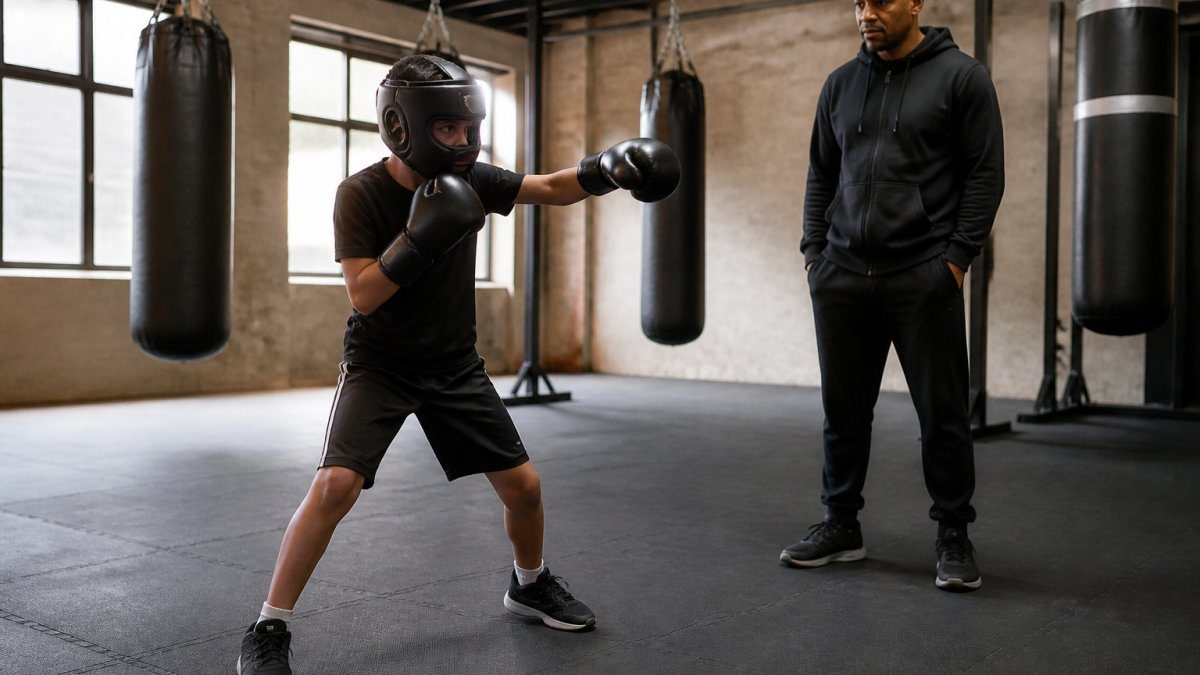
A typical session looks like this:
- Warm-up and movement work: jumping rope, agility ladders, footwork patterns.
- Technique drills: stance, guard, punching form on mitts and bags.
- Coordination work: shadow boxing, mirror drills, rhythm and balance.
- Conditioning: bodyweight strength, core work, light cardio.
- Cool-down and a short talk on discipline or goals.
Notice what is missing: no child gets hit in the head, or hit at all.
Non-contact boxing delivers the physical activity, discipline, and self-defense fundamentals parents want without the sparring risk. “Boxing” gets treated as one thing when it is really three: non-contact training, sparring, and competition.
Boxing Protective Gear for Kids: What Fits and What Matters
Boxing protective gear for kids only works when it fits, and fit is where most programs cut corners.
Here is what a well-equipped young boxer needs, and how each piece should fit:
| Gear | Purpose | Fit Check |
|---|---|---|
| Hand wraps | Support wrists and knuckles | Snug, no bunching at the palm; wrap between the fingers, not just around the knuckles |
| Boxing gloves | Protect hands and knuckles | Fingers reach the end, thumb secure, no room to slide; check the size chart by hand circumference, not age |
| Mouthguard | Protect teeth and jaw | Custom or boil-and-bite, stays put when the child talks and drinks; replace when it loosens |
| Headgear | Cushion the head against cuts and bruises | Snug, vision clear, chin covered, no rotation when pushed |
| Jump rope | Warm-up and footwork | Any length, cut to height |
A few honest notes. Headgear reduces cuts and bruises but does not prevent concussion; no equipment does.
Training gear versus sparring gear. The table covers non-contact training.
What gear cannot do. Equipment is the last line of defense, not the first.
A common mistake is buying gloves a size up so the child “grows into them.” Oversized gloves let the hand slide inside, which raises the risk of a jammed thumb or wrist. Buy for the hand you have now.
Another common mistake is treating headgear as a green light for harder contact. Headgear protects skin and bone; it does not make repeated head impacts safe.
A practical gear checklist for parents:
- Ask the coach for the program’s written equipment policy, including what is provided and what you must buy.
- Confirm hand and head measurements before buying; bring the child to the fitting if possible.
- Inspect gloves and headgear for cracks, compressed foam, or loose stitching before each season.
- Replace mouthguards after growth spurts or dental work.
- Never let a child spar in gear that was not fitted for them, even for a single round.
Gear matters, but it is one part of a safety system.
Choosing Boxing Classes for Children: Age, Coaches, and Supervision
Boxing classes for children are only as safe as the coach running them. Age suitability, certification, and supervision matter more than any piece of equipment.
On age, there is no single national minimum for youth boxing programs.
What to look for in a program:
- Certified coaches with real credentials, not just former fighters.
- A written safety policy covering sparring and head contact.
- Small coach-to-child ratios during drills.
- A clear separation between training groups by age and experience.
- A gym culture where kids are taught control, not aggression.
At TEAM DNA Boxing Club, our coaches hold USA Boxing affiliation and AIBA one-star certification, and we run programs for all ages from five to seventy.
Questions to Ask a Youth Boxing Coach Before You Enroll
Questions to ask a youth boxing coach should cover safety policy, coaching credentials, and what a normal week looks like. Ask in person and watch how the coach answers; evasions tell you as much as answers.
Here is the list we would want a parent to bring us:
- Are your coaches certified, and by whom?
- Does my child spar? If so, at what age and how often?
- What is your policy on head contact during training?
- How do you handle a suspected concussion?
- What does a typical week look like?
- How do you group kids by age and skill?
- What is the coach-to-child ratio during drills?
- How do you teach discipline and self-control, not just punching?
That last one is non-negotiable. A program with nothing to hide lets parents watch.
Ask the coach to describe a recent time a kid got hurt and what happened next. The answer tells you more about the program’s safety culture than any brochure.
Recognizing Concussion and Responding to Injuries
Recognizing a concussion quickly is a skill every parent of a young athlete should have.
Warning signs to watch for after any head impact:
- Headache or pressure in the head
- Dizziness or balance problems
- Nausea or vomiting
- Confusion or trouble concentrating
- Sensitivity to light or noise
- Slowed speech or reaction time
- Mood or behavior changes
- Memory problems, such as not remembering the impact or the minutes around it
- Drowsiness or trouble waking up
Red flags that require emergency care right away. Call 911 or go to an emergency department if a child shows any of the following after a head impact:
- Loss of consciousness, even briefly
- Seizure or convulsion
- Repeated vomiting
- One pupil larger than the other
- Clear fluid or blood from the nose or ears
- Increasing confusion, agitation, or unusual behavior
- Weakness or numbness in the arms or legs
- A headache that gets worse over time
If you see any warning sign short of a red flag, pull the child from activity immediately. The CDC’s concussion guidance for parents lays out the return-to-activity steps clearly.
What the return actually looks like. The CDC’s approach, used widely in youth sports, separates recovery into stages rather than a single “you’re cleared” moment:
- Return to regular activities (school) first. Most children need to resume light cognitive activity and school before returning to sport. A brief period of rest is common, but prolonged darkness and isolation are no longer recommended.
- Light aerobic activity. Walking or stationary cycling at a low, symptom-free intensity.
- Sport-specific exercise. For a boxer, this might mean shadow boxing and footwork with no contact.
- Non-contact training drills. Mitt work and bag work, still no sparring.
- Full-contact practice only after medical clearance. This is the step where a qualified clinician signs off, not a coach.
- Return to competition. The final step, and the one that should never be rushed.
Separate each stage by at least 24 hours, and a child who develops symptoms at any stage goes back to the previous step.
Second-impact risk. Returning to contact before the brain has healed raises the risk of a second injury, which can be more serious than the first.
When in doubt, sit them out. No practice, drill, or competition is worth risking a second impact before the brain has healed. And a coach who argues with that rule is telling you something important about the program.
What to ask the program before an injury happens:
- Who evaluates a child after a head impact, and what are their qualifications?
- Is there a written concussion policy, and does it follow current CDC or state guidance?
- Who has the authority to pull a child from training, and can a parent override it?
- What is the return-to-sport process, and does it require medical clearance before contact?
- Are coaches trained to recognize concussion signs, and how recently?
Having those answers before anyone gets hurt separates a program that manages risk from one that improvises.
Conclusion
The honest answer to whether boxing is safe for children is that it depends almost entirely on the program. Non-contact training builds fitness, discipline, and confidence with low risk. Sparring and competition raise the stakes, and parents deserve straight answers before signing up.
At TEAM DNA Boxing Club, we built our youth program around that distinction. Our coaches hold USA Boxing affiliation and AIBA one-star certification, we run age-appropriate training from five upward, and we treat discipline and self-control as the point of the sport, not an afterthought.
Frequently Asked Questions
What age can children start boxing?
Most youth programs, including USA Boxing-affiliated clubs, set a minimum age around 8 for structured classes, though some gyms run movement and fitness sessions for ages 5 to 7. The American Academy of Pediatrics recommends pediatricians strongly discourage competitive boxing for children and adolescents, so age alone does not settle the question. What matters more is whether the program separates age groups, keeps kids boxing without sparring until they are older, and pairs every child with qualified coaching and supervision.
Is boxing safe for children if they do not spar?
Non-contact training removes the repeated head impacts that drive the biggest safety concerns. Kids boxing without sparring focuses on footwork, punching technique on bags and mitts, coordination, and fitness, which carries far lower injury risk than competition. A 2011 review in Pediatrics reported head, face, and neck injuries made up 6.5% to 51.6% of boxing injuries across the studies it examined, and those figures include sparring and bouts. Ask any gym to confirm in writing that children do not spar and that head contact is not part of class.
What protective equipment do children need for boxing?
At minimum, kids need properly fitted boxing gloves, hand wraps, and a mouthguard once any contact drills begin. Headgear is required for sparring and amateur competition, but it does not prevent concussion, so it should never be treated as a substitute for limits on head contact. Gear must fit correctly: loose gloves cause wrist strain and oversized headgear blocks vision. Ask whether the gym supplies equipment or expects you to buy it, and check that coaches inspect fit before every session.
How can parents tell if a youth boxing gym is safe?
Watch a full class before enrolling. Look for certified coaches, clear safety rules, age-grouped sessions, and a written policy on sparring and concussion. Ask questions to ask a youth boxing coach directly: what certifications they hold, whether children spar, how they handle a suspected concussion, and what a typical week looks like. A 2011 Nationwide Children’s Hospital analysis found boxing injuries rose 211% between 1990 and 2008, so a gym that treats head safety casually is a red flag regardless of how good its reputation is.
