
Is Boxing Training Good for Inner City Youth?
Last Updated: October 30, 2026
Quick Summary
Boxing training for inner city youth works because it pairs demanding physical discipline with consistent adult mentorship, giving young people a structured outlet for energy, stress, and aggression. The routine of a youth boxing program offers predictability that kids whose home lives or neighborhoods are unpredictable rarely get. Kids who train consistently tend to handle frustration better, listen more carefully, and take pride in small improvements.
- Most teenagers do well training two to three times per week, with at least one rest day between hard sessions.
- A clear red flag is a gym that puts beginners into contact sparring in the first few weeks.
- Ask whether a program offers scholarships, sliding scales, loaner gear, transit help, or meal support.
- Confirm at least one coach on site holds current CPR and first-aid certification, and that all adults are background-checked.
- TEAM DNA Boxing Club is affiliated with USA Boxing and holds AIBA one-star certification, with more than 25 years of experience.
Table of Contents
- Why Boxing Training Works for Inner City Youth
- The Benefits of Boxing for Youth Beyond the Ring
- How to Start: Boxing Training for Beginners
- How Often Should a Teenager Train in Boxing?
- Youth Boxing Safety: What to Look For
- What Membership and Costs Look Like
- Request More Info From TEAM DNA Boxing Club
- Frequently Asked Questions
Why Boxing Training Works for Inner City Youth
Boxing training for inner city youth works because it pairs demanding physical discipline with consistent adult mentorship, giving young people a structured outlet for energy, stress, and aggression. Boxing pairs that combination with consistent coaching and mentorship, which can help young people carry themselves with more discipline at home, in school, and on the street.
The structure matters as much as the sport. Community-based programs have been studied for exactly this reason, including a participatory action research project at the Downtown Boxing Gym that examined how youth researchers experienced a boxing-based community program.
The Benefits of Boxing for Youth Beyond the Ring
The benefits of boxing for youth go well beyond punches landed. They show up in how a teenager talks to a coach, handles a loss, and finishes something hard.
Confidence, Discipline, and Self-Control
Confidence in boxing is earned in small increments as skills build over time. Self-control develops alongside it, because losing your temper costs you immediately: you drop your guard, you get hit, you learn.
Discipline here is not a lecture. It is a rule set: wrap your hands, respect your partner, touch gloves, stop when the bell rings. Teens internalize those rules faster than advice, and the habits travel. For parents who want practical steps outside the gym too, our guide on how to build confidence in teenagers pairs well with what happens in the ring.
Fitness, Coordination, and Healthy Habits
Boxing builds fitness in a way that feels like a byproduct rather than a chore. Warm-ups, cardio conditioning, and technical sparring cover strength, endurance, agility, and coordination in a single session, which is why youth programs increasingly combine instruction with conditioning work. A scoping review of boxing as a mental health intervention identified 16 documents describing improvements across various mental-health difficulties, though it did not isolate youth-only results. Treat that as encouraging, not conclusive.
Motor skills improve fast. Footwork teaches balance and body awareness. Punching technique builds coordination between hips, shoulders, and hands. Healthy habits can follow as training becomes part of a routine.
How to Start: Boxing Training for Beginners
Starting boxing training for beginners is straightforward: find a program that teaches fundamentals before contact, show up consistently, and let a coach correct you. No prior athletic experience is required.
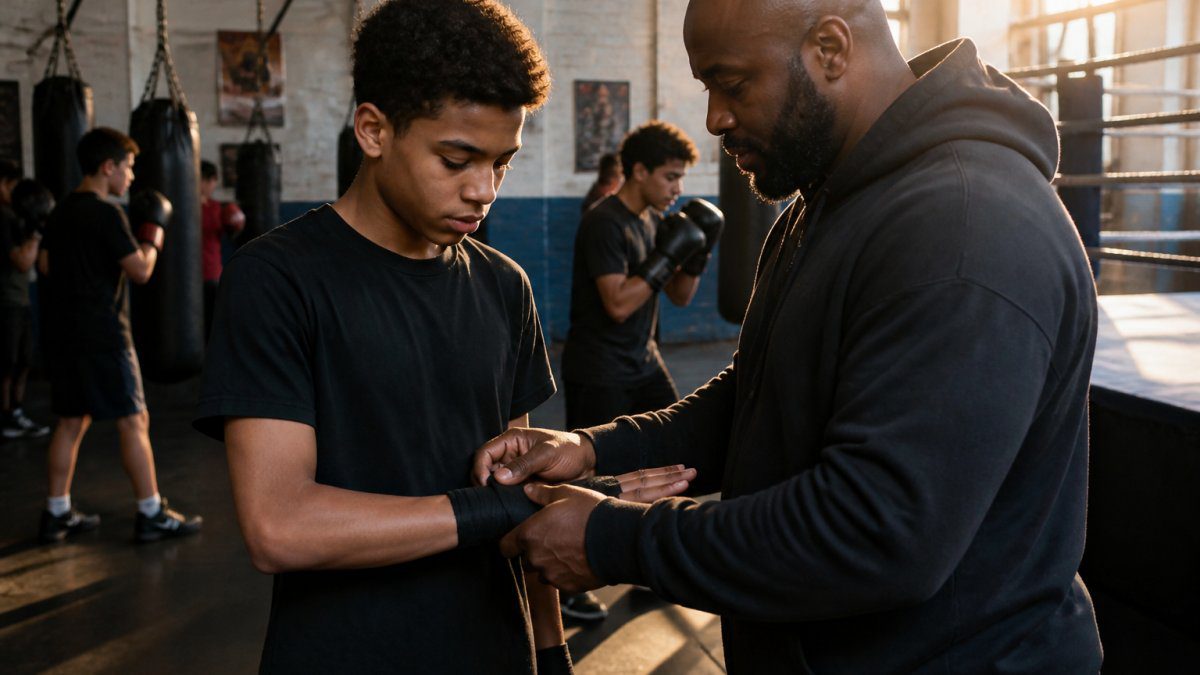
What a First Class Actually Looks Like
Beginner classes generally emphasize instruction over contact, and sparring is typically introduced only after a coach judges a beginner ready. If your child has never boxed, our beginner’s guide to starting with no experience walks through the first few weeks in more detail.
Choosing a Program: What Parents Should Ask
Ask these questions before you enroll in any program:
- Are coaches certified, and through which body?
- What is the coach-to-student ratio?
- When does contact sparring begin, and is it optional?
- What safeguarding and supervision policies are in writing?
- Is there a trial class or observation visit?
The quality of the mentor matters more than the equipment. Our article on what to look for in youth mentors explains what to look for in a mentor.
How Often Should a Teenager Train in Boxing?
Most teenagers do well training two to three times per week, with at least one rest day between hard sessions.
Frequency is where enthusiasm and injury risk collide. A teenager who trains five days in their first month is heading for an overuse injury or burnout. Three focused sessions beat five sloppy ones every time. A typical week might look like this:
| Day | Focus | Duration |
|---|---|---|
| Monday | Fundamentals and footwork | 60 min |
| Wednesday | Conditioning and bag work | 60 min |
| Friday | Technique and light partner drills | 60 min |
| Weekend | Rest or light activity | , |
Young athletes competing at a higher level may train more, but that decision belongs to a coach who knows the individual.
Youth Boxing Safety: What to Look For
Youth boxing safety generally comes down to supervision, progression, and equipment. A safe program teaches defense first, delays sparring, and matches partners by size and experience.
Supervision and Coach-to-Student Ratios
Ask who is on the floor and how many kids each coach can actually see. Confirm that at least one coach on site holds current CPR and first-aid certification, and ask whether a background check is required for every adult in the room. USA Boxing publishes coach certification and safe-sport requirements that a reputable program can point to (Coach Membership).
Concussion Awareness and Return-to-Training
Any contact carries concussion risk, and a program’s protocol should be written, not improvised. Look for these elements:
- A stated rule that any athlete with a headache, dizziness, nausea, confusion, or balance problems is pulled from training immediately.
- A requirement that a youth athlete be cleared by a health care provider before returning to contact drills.
- A graduated return that separates conditioning and bag work from partner contact, so a kid is not thrown straight back into sparring.
- Coaches trained to recognize signs rather than waiting for a kid to report them, since young athletes often hide symptoms to stay in the gym.
The Centers for Disease Control and Prevention’s HEADS UP materials are a widely used free reference for youth sports concussion policy, and a program that follows them can usually show you the paperwork.
Protective Equipment and Hygiene
For any contact work, parents should confirm that hand wraps, properly fitted mouthguards, and headgear are required, and that sparring gloves are distinct from bag gloves. Ask whether the gym supplies loaner gear, and inspect its condition: cracked headgear and worn-out gloves are a safety problem.
Age-Appropriate Drills and a Non-Contact Pathway
Not every young boxer needs to spar, and a strong program says so out loud. Beginners should spend weeks on stance, guard, footwork, and punching mechanics on bags and in shadowboxing before any partner contact. Some programs offer a non-contact track built around mitt work, heavy bag rounds, and conditioning. For younger children especially, the emphasis should be coordination, balance, and listening rather than hitting a moving target. Parents with deeper concerns should read our full guide on whether boxing is safe for children, which covers injury prevention and age-appropriate training in detail.
A clear red flag is a gym that puts beginners into contact sparring in the first few weeks.
Questions That Reveal a Safe Program
Bring this list to any visit:
- Is there a written concussion policy, and who clears an athlete to return?
- What is the coach-to-student ratio during bag work and during partner drills?
- Are all coaches background-checked and CPR/first-aid certified?
- Is sparring optional, and at what point is a beginner considered ready?
- Is there a non-contact option for kids who are not ready or not interested?
- How is shared gear cleaned, and is loaner equipment available?
A program that answers all six without hesitation is one you can trust with a teenager.
What Membership and Costs Look Like
Membership costs vary by program, schedule, and whether a gym is nonprofit or private. Contact TEAM DNA Boxing Club on its website for current prices or a quote. Here is how to evaluate cost and where the real affordability levers are, because for inner-city families the monthly fee is rarely the only barrier.
Reading a Price Tag Correctly
Compare the monthly fee against the number of classes included, not the headline number. A monthly fee that covers more sessions can be a better value than a lower fee that covers fewer. Ask these questions before you commit:
- Does the fee include open gym time, or only scheduled classes?
- Is gear provided, or is hand wraps, gloves, mouthguard, and headgear an added cost?
- Is there an annual registration or insurance fee on top of the monthly rate?
- Are there family discounts for siblings?
- Is there a trial class or a short observation period before payment?
A common pattern is a nonprofit gym charging less per month but requiring a USA Boxing membership for any athlete who competes, which is a separate annual cost. Ask which fees are mandatory for beginners and which only apply to competitors.
Scholarships, Sliding Scales, and Fee Waivers
Affordability is a real barrier, and it is worth asking directly about financial assistance rather than assuming you do not qualify. Many community and nonprofit programs offer financial assistance options, and it is worth asking directly about them. The question to ask is plain: “Do you have a scholarship or sliding-scale option, and what is the application?”
Equipment Assistance
Gear can be a hidden cost for families. A beginner typically needs hand wraps, bag gloves, and a mouthguard, plus headgear and sparring gloves if contact work is involved. Ask whether the gym keeps loaner gear before buying equipment up front.
Transportation and Meal Support
Two barriers get overlooked in cost conversations. Two barriers are often overlooked. The first is transportation: ask whether a program offers transit help or a location near a transit line. The second is food: ask whether a snack or meal is provided for evening sessions.
Evaluate cost as total participation cost, not monthly dues: fees plus gear plus transportation plus food. Then ask specifically about scholarships, sliding scales, loaner equipment, and transport support. The programs built for inner-city youth expect that question.
You can review membership options before you visit, and bring the questions above to the conversation.
Request More Info From TEAM DNA Boxing Club
The hardest part is walking through the door the first time.
TEAM DNA Boxing Club is affiliated with USA Boxing and holds AIBA one-star certification, with more than 25 years of experience. Programs are open to ages 5 to 70, and the traveling team has national reach.
Get started with TEAM DNA Boxing Club and give your child a place to build discipline, confidence, and self-control that lasts well beyond the final bell.
Frequently Asked Questions
At what age can a child start boxing training?
Minimum ages vary by program. TEAM DNA Boxing Club works with members from age 5 to 70, so younger kids can begin with age-appropriate fundamentals and conditioning rather than contact work. Before enrolling, ask what the coach does differently for beginners under 12, and confirm the program groups kids by age and skill level so your child is not thrown in with experienced teens.
Is boxing safe for kids and teenagers?
Youth boxing safety depends on how the program is run. Look for certified coaches, USA Boxing affiliation, age-appropriate training, and a clear policy on when sparring starts. Beginners should spend weeks on stance, footwork, and bag work before any contact. Ask whether headgear and mouthguards are required and whether a coach is trained in first aid. A program that treats safety as a checklist, not a sales pitch, is the one to trust.
How often should a teenager train in boxing?
Two to three sessions a week is a reasonable starting point for most teens, with at least one rest day between hard workouts. That schedule builds boxing fundamentals and conditioning without overtraining. Watch for signs of burnout, such as dropping grades or dreading practice, and adjust. Consistency over months matters more than stacking sessions in a single week.
What are the benefits of boxing for youth?
Boxing training builds confidence, discipline, and self-control alongside fitness, coordination, and endurance. Youth also learn footwork, stance, and punching technique that carry into other sports. Research on boxing as a form of exercise is still developing, and youth-specific outcomes are not yet well established.
