
Boxing Drills for Improved Child Focus and Discipline
Last Updated: November 14, 2026
Quick Summary
Boxing drills improve a child’s focus because every punch demands attention, and dropping the guard for one second gets an instant mitt tag that trains concentration faster than most classroom exercises. Structured boxing drills train body and brain together: stance builds balance, footwork builds controlled movement, and mitt work builds reaction time.
- A study of 1.2 million individuals linked boxing training to a 20.1% drop in mental health burden.
- Set up at least 8 feet by 8 feet of clear space with hand wraps and youth gloves of 4 to 6 ounces.
- Hold stance for 20 seconds with 10 seconds rest, repeating five times; ages 5-6 hold 10 seconds four times.
- Run the 20-minute beginner session two to three times per week and tally correct sequences and guard resets.
- Keep rounds to 30-60 seconds for kids with ADHD and give one instruction at a time.
Table of Contents
- Why Boxing Drills Sharpen a Child’s Focus
- What You’ll Need Before the First Drill
- Step-by-Step Boxing Drills for Improved Child Focus
- Boxing Drills for Kids at Home: Space and Equipment Alternatives
- Boxing Games for Kids That Build Concentration
- Kids Boxing Workout Duration: How Long Is Right?
- Boxing Drills for Kids with ADHD: Adaptations That Work
- Common Mistakes to Avoid When Coaching Focus Drills
- Frequently Asked Questions
Why Boxing Drills Sharpen a Child’s Focus
Boxing drills for improved child focus work because every punch demands attention. A child who drops their guard for one second gets tagged with a mitt.
The evidence backs this up.
Boxing drills are structured, repeated movement patterns that train body and brain together: stance builds balance, footwork builds controlled movement, mitt work builds reaction time.
Want the discipline angle in more depth? Read our guide on how to build discipline in youth.
What You’ll Need Before the First Drill
You need four things before your child throws a single punch: space, hand wraps, gloves, and a coach who teaches safety first.
Here is the starter checklist:
- Clear space of at least 8 feet by 8 feet
- Hand wraps sized for small hands
- Youth boxing gloves, 4 to 6 ounces
Skip the heavy bag at first. Beginners learn stance and footwork better without one. Add equipment as skills improve.
Safety comes before intensity. Non-contact boxing exercises are a promising way to improve mental health burden, according to a 2022 scoping review in the NCBI database.
Step-by-Step Boxing Drills for Improved Child Focus
These five drills build in order, each adding a layer of attention. Each includes setup, steps, coaching cues, duration, progression, and the common mistake to watch for.
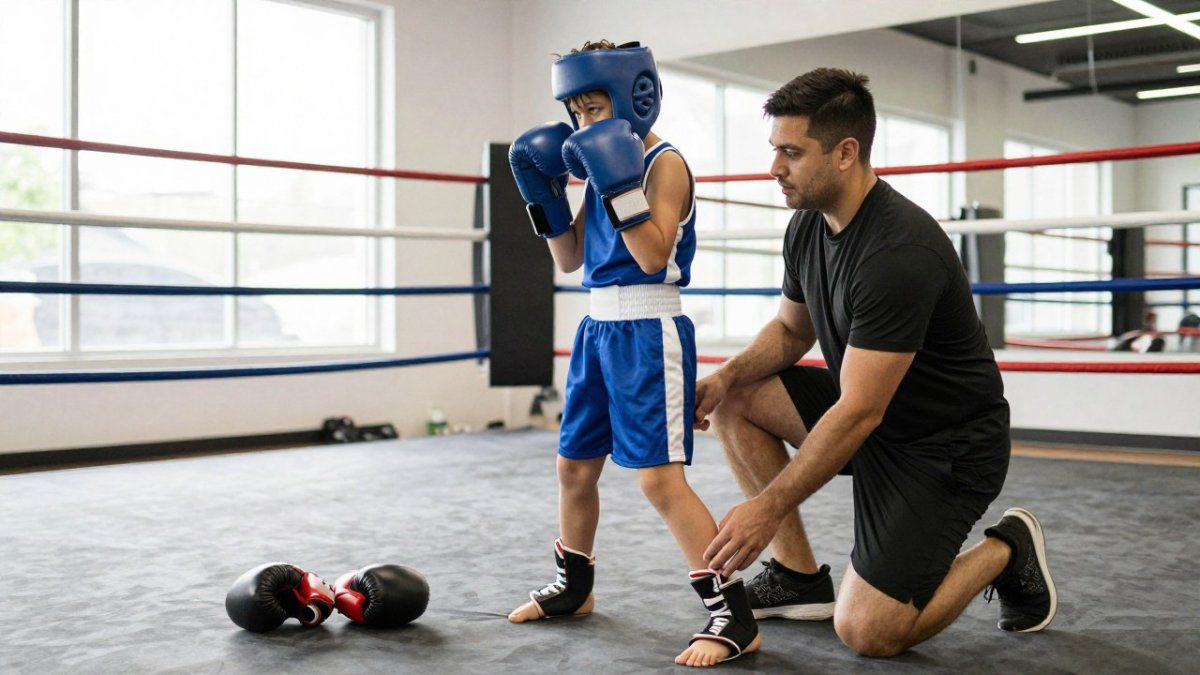
Stance and Balance: The Foundation of Focus
Setup: Clear 8 feet by 8 feet of floor. No equipment needed.
Steps:
- Feet shoulder-width apart, lead foot forward, back heel slightly lifted.
- Knees bent as if sitting on a small chair.
- Hands up at cheek level, elbows tucked to the ribs.
- Chin down, eyes forward on a fixed target at eye level.
Duration: Hold 20 seconds, rest 10 seconds, repeat five times. Ages 5-6 can hold 10 seconds and repeat four times.
Progression: Once the hold is clean, add a slow weight shift from front foot to back foot while keeping hands up.
How to observe focus: Count how many times your child’s eyes leave the target or hands drop below the chin during the 20 seconds.
Footwork and Controlled Movement Drills
Setup: Four cones in a 6-foot square, or tape squares on the floor for a ladder.
Steps:
- Start in stance at the front-left cone.
- Shuffle forward to the front-right cone, keeping hands up and feet never crossing.
- Shuffle back, then left, then right, returning to start.
- Coach calls a direction; child moves only on the call.
Duration: Three rounds of 30 seconds with 30 seconds rest. Ages 5-6: two rounds of 20 seconds.
Progression: Add a jab at each cone.
How to observe focus: Note whether the child moves on the call or drifts ahead of it.
Watch out: crossing feet or dragging the back leg both signal the pace is too fast.
Jab, Uppercut, and Punch Combination Drills
Setup: Open floor, mirror optional. No contact.
Steps:
- Jab: straight punch from the lead hand, thrown and pulled back fast, elbow returning to the ribs.
- Uppercut: bend the knees, drop the shoulder slightly, drive upward with control.
- Combine into jab, jab, uppercut, calling the numbers out loud (“one, one, two”).
Coach cues: “Snap it back.” “Turn the hip, not the shoulder.” “Say the number as you throw it.”
Duration: Three rounds of 45 seconds with 15 seconds rest. Ages 5-6: 30-second rounds.
Progression: Move from calling numbers aloud to the coach calling while the child stays silent, then to throwing the sequence in reverse.
How to observe focus: Count correct sequences out of ten attempts. Track it across sessions; a rising count is a practical focus metric you can show a parent or teacher.
Watch out: kids rush the uppercut and wind up like a baseball swing.
Focus Mitt and Shadowboxing Drills
Setup: One pair of focus mitts and a coach or parent who has reviewed proper hand position. Mirror for shadowboxing.
Steps:
- Coach holds mitts at cheek and rib height and calls a number for each mitt.
- Child punches the called mitt and returns to guard.
- For shadowboxing, child faces the mirror and throws the jab-uppercut combo at half speed, then full speed.
Duration: Mitt work three rounds of 60 seconds with 30 seconds rest. Shadowboxing 45 seconds on, 15 seconds off, three rounds.
How to observe focus: Watch the return to guard.
Watch out: kids rush shadowboxing and lose form. Slow them down until the technique is clean, then add speed.
A Ready-to-Use 20-Minute Session Plan
Here is how the five drills fit into one beginner session for ages 7-9. Ages 5-6 should cut each block in half and take a 60-second rest between blocks.
| Block | Drill | Time | Focus Target |
|---|---|---|---|
| 1 | Warm-up: arm circles, light shuffles | 3 min | Getting moving |
| 2 | Stance and balance holds | 3 min | Eyes on target, hands up |
| 3 | Footwork cone shuffles | 4 min | Moving on the call |
| 4 | Jab and uppercut combinations | 4 min | Correct sequences out of ten |
| 5 | Focus mitts | 4 min | Return to guard every punch |
| 6 | Shadowboxing cooldown | 2 min | Slow, clean form |
Run this two to three times per week. Tally correct sequences and guard resets each session; after four weeks you will have a real record of attention gains.
Age and Ability Adaptations
- Ages 5-6: Halve every duration, use one instruction per round, and keep all drills air-based. Skip mitt work until the child can hold stance for 20 seconds without prompting.
- Ages 7-9: Use the full session plan above. Add one new combination per week, not per session.
- Ages 10-12: Extend rounds to 60-90 seconds and add a two-step coach call in footwork. Introduce light bag work only after form is consistent.
Boxing Drills for Kids at Home: Space and Equipment Alternatives
Home boxing drills for kids work in a garage, driveway, or cleared living room, no full gym needed, just enough room to move safely.
Try these space-friendly options:
- Shadowboxing: zero equipment, any clear space
- Footwork ladders: tape squares on the floor
- Focus mitts: a parent holds them, no bag needed
A free-standing bag sized for kids is the best home upgrade. Our youth free standing punching bag fits small spaces and takes punishment that walls should not.
Set a hard rule: no punching furniture, walls, or siblings. Home training stays structured, not chaotic.
Boxing Games for Kids That Build Concentration
Boxing games for kids turn focus training into play, and kids try harder when it feels like a game.
Four games that build concentration skills:
- Number call-out: Coach calls “1” through “4,” each number a different punch. Kid reacts fast.
- Mirror drill: Child copies the coach’s movements exactly, like a mirror.
- Freeze: Music plays, kid shadowboxes; when it stops, kid freezes in a perfect stance.
- Target tag: Coach moves a single mitt around; kid chases it with light taps.
Each game lasts 60 to 90 seconds; short rounds keep attention sharp while building real coordination and movement control.
Kids Boxing Workout Duration: How Long Is Right?
Kids boxing workout duration should run 20 to 30 minutes for ages 6 to 9, and 30 to 45 minutes for ages 10 and up. Shorter, focused sessions beat long ones.
Here is the breakdown:
| Age Group | Session Length | Rounds | Rest Between Rounds |
|---|---|---|---|
| Ages 5-6 | 15-20 minutes | 4-6 | 60 seconds |
| Ages 7-9 | 20-30 minutes | 6-8 | 45-60 seconds |
| Ages 10-12 | 30-40 minutes | 8-10 | 30-45 seconds |
| Ages 13+ | 40-45 minutes | 10-12 | 30 seconds |
Session Length
Two to three sessions per week is enough for beginners. Young athletes need rest days to grow and recover.
Curious what a full program looks like? See our rundown of the benefits of after-school boxing for kids and teens.
Boxing Drills for Kids with ADHD: Adaptations That Work
Boxing drills for kids with ADHD work best in short rounds with clear cues and instant feedback. Structure does the heavy lifting. But it is worth being precise about what the drills do and do not do, because most articles on this topic blur the two.
What the drills build is a set of trainable skills: following a multi-step cue, staying on task for a short round, and returning attention after a distraction. Researchers say more well-designed studies are needed before boxing is a standard mental health treatment, and a 2022 scoping review in the NCBI database frames non-contact boxing as a promising but early area of study.
Adaptations That Match How Attention Actually Works
- Keep rounds to 30-60 seconds, then rest. Short rounds match the attention span you are training, and the rest is part of the drill.
- Give one instruction at a time. Add a second cue only after the first is reliable.
- Use numbered punch calls so the child has a job every second. Idle time is where attention drifts.
How to Observe Progress Without a Clinical Claim
You do not need a diagnosis or a formal assessment to see whether the drills are helping. Track three simple markers across four weeks:
- Multi-step cues followed correctly. Count how many two-step coach calls the child completes without a repeat; a rising count signals working memory and attention gains.
- Time on task. Note how many seconds into a round form breaks down. Growing from 20 to 40 seconds means the drill is working.
- Return after distraction. Introduce a distraction, a dropped mitt, a called name, and see how quickly the child returns. Faster returns are the clearest practical sign of attention control.
Keep the tally on a simple sheet to notice changes over time.
Safety and Supervision for This Group
- No head contact, ever, in these drills. All work is air-based or mitt-based, with zero sparring.
- One coach, one voice. Two adults giving cues at once is the fastest way to lose a child’s attention mid-drill.
- Rest is non-negotiable. End the session while the child still has attention left.
Common Mistakes to Avoid When Coaching Focus Drills
The biggest coaching mistake is adding speed before form. Fast punches with bad technique teach habits that take months to undo.
Other common errors:
- Too many instructions at once. One cue per round.
- Skipping the warm-up. Cold muscles and cold attention both fail.
- Long sessions. Tired kids stop focusing, and form collapses.
Watch out: parents sometimes coach over a certified trainer mid-drill. Pick one voice so the child isn’t getting two sets of cues.
If you want outside coaching, learn how to find reputable youth boxing coaches before you commit.
Focus doesn’t arrive on its own.
Frequently Asked Questions
Is boxing good for a child with ADHD?
The structured repetition, movement patterns, and coaching cues in boxing drills can help children practice sustained attention and self-control. Research on this topic is still developing, so boxing should be viewed as a training tool rather than a treatment.
What are some good boxing drills for kids to practice at home?
Start with shadowboxing in front of a mirror for 2-minute rounds, practicing jab-cross combinations. Add footwork ladder drills using tape on the floor, and cone exercises for controlled movement. A heavy bag or pillow can substitute for focus mitts if a partner is available. Keep sessions to 15-20 minutes for younger children. These boxing drills for kids at home build hand-eye coordination and concentration without needing a full gym.
How long should a boxing workout be for a child?
For children ages 5-8, keep sessions to 20-30 minutes with frequent water breaks. Ages 9-12 can handle 30-45 minutes, and teens can train 45-60 minutes. The kids boxing workout duration should prioritize quality repetition over length. Shorter, focused sessions with clear coaching cues build concentration skills better than long, unfocused workouts.
Can kids practice boxing drills without sparring?
Yes. Non-contact boxing drills, including shadowboxing, focus mitt work, heavy bag training, and footwork ladder drills, build coordination, discipline, and confidence without sparring. Many focus drills require no partner at all.
