
Boxing for Beginners With No Experience: Start Strong
Table of Contents
- Why You Can Start Boxing With Zero Experience
- Your First Week: A Simple Beginner Boxing Workout Plan
- The Four Basic Punches and Your First Combinations
- Boxing Drills for Beginners at Home (No Equipment Needed)
- First Boxing Class: What to Expect and How to Prepare
- Boxing Equipment for Beginners: What You Actually Need
- How to Choose a Beginner-Friendly Gym and Evaluate Coaching
- Safety, Injury Prevention, and Realistic Progress Milestones
- Frequently Asked Questions
Last Updated: October 19, 2026
Why You Can Start Boxing With Zero Experience
Boxing for beginners with no experience works because the sport teaches technique before it demands intensity, which is why boxing for beginners is so accessible.
The barrier most people imagine is fitness. It is not.
Here is what actually matters on day one:
- Show up in comfortable clothes and athletic shoes
- Bring water and a willingness to learn slowly
- Expect to feel uncoordinated, because everyone does
The USA Boxing club finder can help you understand how sanctioned gyms and programs are structured. A certified coach will meet you where you are.
The first month is about repetition, not results. Our coaches would rather see a slow, clean jab than a fast, sloppy one. Clean technique sticks; bad habits take months to undo.
Your First Week: A Simple Beginner Boxing Workout Plan
A beginner boxing workout should last 20 to 30 minutes and mix technique with light conditioning. This first-week plan assumes no fitness or boxing background. Do it at home or in a gym, and stop any drill if you feel pain. The goal is repetition of stance, guard, and the first two punches until they become automatic.
Every session follows the same five-part structure:
- Warm-up (3 minutes): march in place, arm circles, shoulder rolls, hip circles, and 10 slow bodyweight squats.
- Technique block (8-10 minutes): one skill only, practiced slowly in front of a mirror.
- Punch or footwork rounds (6-9 minutes): 3 rounds of 1-2 minutes with 30-60 seconds rest.
- Light conditioning (3-5 minutes): bodyweight only, no jumping if your knees or neighbors object.
- Cool-down (2 minutes): walk, shake out arms, stretch shoulders and calves.
Days 1-3: Learn the Stance, Guard, and Footwork
Spend 10 minutes a day on the basics. Stand with feet shoulder-width apart, lead foot forward, knees soft, hands at your cheekbones with elbows tucked, that is your guard. Practice stepping forward and back without crossing your feet.
- Day 1, Stance and guard: 3 minutes warm-up, 5 minutes holding guard in the mirror (check chin down, elbows in, hands at cheekbones), 2 minutes stepping forward and back. No punches.
- Day 2, Guard and pivot: repeat day 1, then add 2 minutes of pivoting on the lead foot (turn the lead toe outward 45 degrees and back) to learn how to open your hips.
- Day 3, Footwork: 3 minutes warm-up, 6 minutes of forward, back, and lateral steps with hands in guard, 1 minute of shadowboxing footwork only. Keep the guard up the whole time.
Days 4-5: Add the Jab and Cross
Add the jab (lead hand) and cross (rear hand) on days four and five, thrown slowly from your guard.
- Day 4, Jab only: 3 minutes warm-up, 5 minutes of slow jabs from guard (return the hand to the cheekbone every rep), 3 rounds of 1 minute jab-only shadowboxing with 30 seconds rest.
- Day 5, Jab and cross: 3 minutes warm-up, 5 minutes of jab-cross in slow motion, 3 rounds of 1 minute jab-cross shadowboxing with 30 seconds rest. Reset your stance after every combination.
Days 6-7: Add Light Conditioning and Your First Combination Rounds
On days six and seven, add light conditioning and link the punches into a combination.
- Day 6, Conditioning: 3 minutes warm-up, 4 minutes of jab-cross technique, then 3 rounds of 1 minute each of bodyweight squats, alternating reverse lunges, and a 30-second plank, with 30 seconds rest between rounds.
- Day 7, Combination rounds: 3 minutes warm-up, 3 rounds of 1 minute of jab-cross-hook shadowboxing with 30 seconds rest, then 2 minutes of easy walking to cool down. Film one round on your phone and watch it back, you will spot a dropped guard faster than you feel it.
| Day | Focus | Time | What to Do |
|---|---|---|---|
| 1 | Stance and guard | 10 min | Hold guard in mirror, step forward and back |
| 2 | Guard and pivot | 10 min | Guard holds plus lead-foot pivots |
| 3 | Footwork | 10 min | Forward, back, lateral steps in guard |
| 4 | Jab | 15 min | Slow jabs, 3 shadowboxing rounds |
| 5 | Jab and cross | 15 min | Slow jab-cross, 3 shadowboxing rounds |
| 6 | Conditioning | 20 min | Squats, lunges, plank, 3 rounds |
| 7 | Combination rounds | 20 min | Jab-cross-hook rounds, film one round |
If you miss a day, do not double up. Repeat the last session you completed and move forward from there. Consistency across four weeks beats one heroic week followed by a week off.
Skip jumping drills if you have knee, ankle, or hip concerns, or if you live above a downstairs neighbor. Bodyweight squats, step-ups, and marching in place deliver the same conditioning without the impact.
By the end of week one you should hold your guard for a full minute, throw a clean jab-cross, and complete three short rounds without losing your stance, the baseline every later week builds on.
The Four Basic Punches and Your First Combinations
The four basic punches are the jab, cross, lead hook, and uppercut. Master each alone before linking them. The jab is your fastest punch and measuring tool; the cross carries rear-hand power; the lead hook swings around the guard; the uppercut comes up the middle.
Your first combination is simple: jab, cross. Throw it slowly, return to guard each time, then reset. Once that feels natural, add a lead hook: jab, cross, hook.
Do not lock your elbows when you punch. A locked elbow on a missed punch can strain the joint. Snap the punch out and bring the hand straight back to your guard.
Boxing Drills for Beginners at Home (No Equipment Needed)
Boxing drills for beginners at home need no equipment. Shadowboxing is the foundation: throw punches at an imaginary opponent while moving your feet, teaching rhythm, balance, and form without gear.
Try these drills in a 3-round format:
- Shadowboxing: 2 minutes of jab and cross, then rest 30 seconds
- Footwork ladder: step forward, back, and side to side for 1 minute
- Bodyweight circuit: jump squats, squats, and core work for 1 minute each
Three rounds, three times a week builds coordination and endurance fast. Do not skip the warm-up, two minutes of light movement protects your joints before you throw anything.
First Boxing Class: What to Expect and How to Prepare
Your first boxing class usually starts with a warm-up, then coach-led technique work, bag work or drills, and a cool-down. Most beginner classes run about an hour.
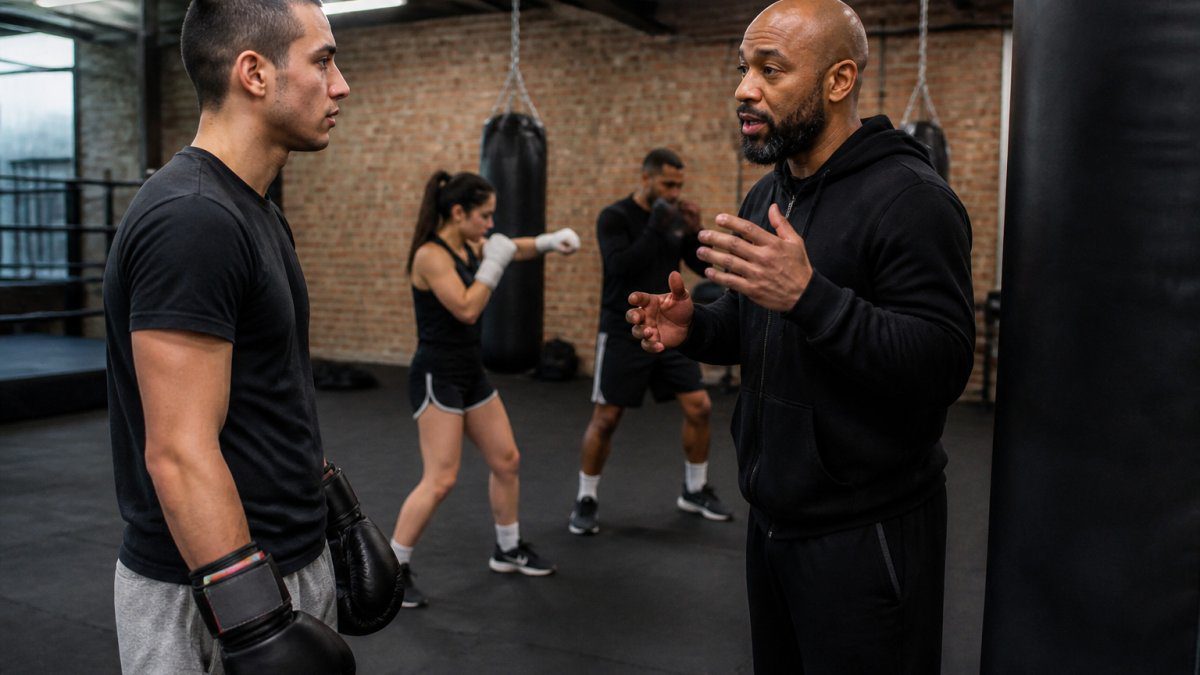
Arrive early, tell the coach it is your first class, and ask what to bring. Wear athletic shoes and comfortable clothes, bring water, and tell the coach about any injury or health concern before class.
The best first class is one where you leave knowing one thing well, not ten things badly. Ask the coach to check your stance and guard before you leave.
Boxing Equipment for Beginners: What You Actually Need
Boxing equipment for beginners comes down to three items: hand wraps, boxing gloves, and comfortable training clothes. Wraps protect your wrists and knuckles; gloves should fit snugly. You do not need a heavy bag or home setup to start.
Hand Wraps: Length and Material
Hand wraps are the first purchase and the cheapest. Most adults use 180-inch wraps, which give more margin for error than 120-inch.
- 180-inch wraps: the default for most adults; enough length to cover knuckles, wrist, and thumb loop.
- 120-inch wraps: workable for smaller hands but easy to run short on wrist coverage.
- Elastic (Mexican-style): better conform to the hand and wrist; slightly more expensive.
Learn to wrap before your first class. A loose wrap slides and exposes the knuckles; an overly tight one restricts blood flow and numbs the fingers. Ask a coach to check your wrap once, then practice at home.
Boxing Gloves: Sizing and Weight
Glove weight is a factor for training. Beginners doing bag and pad work usually start at 14 or 16 ounces because the extra padding protects the hand and wrist while technique develops. Lighter 10- and 12-ounce gloves are reserved for competition or very light bag work.
- Closure: hook-and-loop straps are easier for beginners; lace-up gloves fit more securely but need a partner to tie.
- Padding: look for dense, multi-layer foam over the knuckles; soft foam bottoms out quickly.
- Fit: fingers should reach the end of the glove without curling, and the thumb should sit against the index finger, not across it.
Ask your gym before buying gloves, a coach can check the fit and point you toward the right size.
What You Do Not Need Yet
You do not need a heavy bag, speed bag, custom mouthguard, or boxing shoes in week one. A gym supplies bags and pads, and shoes matter only once you do lateral footwork at speed. Spend your first budget on wraps and gloves, then add items as your coach identifies a real need.
- Athletic shoes: flat, supportive soles help your footwork; running shoes with thick heels can feel unstable.
- Water bottle and towel: simple but essential.
- Mouthguard: only required once sparring is on the table, and your coach will tell you when.
Try gloves on with your wraps on, not bare-handed. Wraps add bulk, and a glove that feels snug without them will feel tight once wrapped.
Never share gloves without cleaning them. Wipe the inside with a disinfecting wipe after each session and let them air dry, glove odor and skin infections both come from damp, stored gear.
How to Choose a Beginner-Friendly Gym and Evaluate Coaching
Choosing a beginner-friendly gym comes down to coaching quality, not equipment. Ask whether coaches hold real certifications, whether beginners are separated from experienced boxers, and whether sparring is optional.
Questions to ask before you join:
- Are the coaches certified, and through what organization?
- How are beginners introduced to the sport?
- Is sparring required, or is it opt-in once you are ready?
A common mistake is choosing a gym on price alone. A cheap class with no structure teaches bad habits. Watch a class before you sign up and see how the coach treats the newest person in the room.
Ask to observe a beginner class, not an advanced one. How a coach talks to the person who just walked in tells you more than any brochure.
Safety, Injury Prevention, and Realistic Progress Milestones
Safety in boxing starts with a proper warm-up, correct hand wrapping, and honest communication with your coach. Stop or modify training if you feel sharp pain, dizziness, or unusual shortness of breath.
Realistic progress milestones look like this:
- Weeks 1-4: learn stance, guard, and the jab-cross
- Months 2-3: link combinations and build conditioning
- Months 4-6: add bag work and controlled drills
Measure progress by form and consistency, not by how hard you hit. For general fitness and safety guidance, the CDC physical activity guidelines offer a solid baseline for adults starting any new sport.
At TEAM DNA Boxing Club, we measure growth in discipline and confidence as much as technique. Beginners who stick with the basics see the fastest progress.
Frequently Asked Questions
Can I start boxing with no experience?
Yes. Boxing for beginners with no experience is the normal starting point at most gyms. You do not need prior fitness, coordination, or fighting background to begin. A good beginner program teaches the stance, guard, footwork, and basic punches before adding intensity. Expect to spend the first few weeks on technique and light conditioning rather than sparring. Show up consistently two to three times per week, and you will build the balance, cardio, and form that make everything else easier.
Do I need to be fit before I start boxing?
No. Boxing itself builds the fitness you need. A beginner boxing workout with bodyweight exercises, jump squats, shadowboxing, and short rounds on the heavy bag develops cardio, core strength, leg power, and endurance over time. Start with shorter rounds and longer rest intervals, then gradually reduce rest as your conditioning improves. If you have an existing injury or health condition, check with a doctor first, and tell your coach so they can modify drills for you.
What equipment do I need for my first boxing class?
Start with hand wraps and a pair of beginner boxing gloves, which protect your hands and wrists during bag work. Add a mouthguard once you begin any contact or sparring, and bring water, a towel, and comfortable athletic shoes. Boxing equipment for beginners does not need to be expensive; fit and wrist support matter more than brand. Ask your coach before buying anything specialized.
How often should a beginner train in boxing?
Two to three sessions per week is a realistic start for most beginners. That gives your body time to recover between workouts while still building technique and conditioning. Each session can include a warm-up, shadowboxing, bag work, and a cool-down. As your form and fitness improve, you can add a fourth day. Rest and recovery matter as much as training, so take at least one full rest day each week and scale back if you feel persistent soreness or joint pain.
Starting boxing with no experience is a challenge, but it is one you do not face alone. TEAM DNA Boxing Club offers certified coaching, USA Boxing affiliation, and mentorship that builds confidence, discipline, and self-defense skills for members of every age. Our programs run from age 5 to 70, with a supportive community behind every round. Get started with TEAM DNA Boxing Club and request more info to find the right program for you.